I had an idea for a social medium that focused on healthy eating, fitness and general wellness. So I put my plan into a white paper.
click the cover to view the white paper.

I had an idea for a social medium that focused on healthy eating, fitness and general wellness. So I put my plan into a white paper.
click the cover to view the white paper.

It was something like 4 o’clock on a Thursday morning. I walked to the kitchen and pounded my head on the counter until coffee magically came out of the machine. I looked at the assortment of bags packed on the floor by the front door—my cute Vera Bradley duffel looked funny hanging out with my fins and snorkel. I headed out the door towards the Aquatic Center with bright eyes. Athens, Ohio had been kissed by one of its first frosts of the year, all the more reason to get the heck down to Florida. As we packed up the trailer and everybody put themselves back to bed, I reviewed what had engulfed my stress for the nine weeks prior: OU SCUBA.
“Did you know SCUBA is actually an acronym?”: the only thing I actually knew about it going into the class.
Our first day was like an episode of “1000 Ways to Die”—SCUBA edition. The instructors sat us down and told us anything and everything that could go wrong while we’re diving. Like how your skin could fall off, or how you could get bubbles in your blood and your skin would fall off, or how the bends would make your skin gross right before you died, or how a shark could come up behind you and tear all of your skin off.
Then we signed a release form.
I immediately called my expert diver boyfriend crying. We had planned a big dive trip to the Dutch Caribbean with his family for Christmas break, but I wasn’t about to go near any water after this first class.
Somehow, I managed to make it to the swim test.
And to the next class.
And to the next pool lab.
And I kept going back, learning something new every time, going out of my comfort zone every time.
The next nine weeks of class gave us more information and practice in the pool than any other introductory SCUBA training I’ve ever heard of. We learned a lot of badass techniques that most divers don’t know—like different kinds of dives, swimming to the bottom of the pool and clearing our mask (getting the water out) all in one breath. We learned how to dive down, gear in hand, and put it all on underwater.
The instructors were total characters, but they also helped you keep calm, while pushing you to push yourself. I have never had a professor genuinely care so much about my success in a class.
At the beginning of pool labs, I was struggling getting my ears to clear on my way to the bottom of the pool—if you don’t clear your ears, the pressure builds up, and the pain is unbearable. My instructor brought me solution for swimmer’s ear the next day.
One instructor had me pushing myself harder than I ever had before. He couldn’t believe how horrible I was at holding my breath. (which, was actually quite horrible.)
“Are you an athlete?” he asked.
“Yes, I’m a runner.”
“Then why do you have no lung capacity to hold your breath?”
“Because when you’re running, you’re allowed to keep breathing.”
We figured out my incapacity to hold any air in my lungs was directly correlated to my incapacity to relax longer than a half second. (Picture me underwater: I’m the guy from Accepted who they finally get to meditate when they put him in a straight jacket.)
“Relax,” he’d tell me. Until I practiced just sitting at the bottom of the pool and letting myself forget that I couldn’t breathe, I was very horrible at relaxing.
It’s funny to me how often many people, upon finding out I was taking SCUBA diving, responded so very cynically. “Oh, I would never take that class. I’m too scared.”
The irony of their responses is that my reason for taking SCUBA diving is exactly that. I was scared. I wanted to challenge myself. I wanted to push myself well beyond my comfort zone. I wanted to poop my wetsuit.
I wanted to let myself relax.
And I’ll admit, I had to go into the aqua center a couple times outside of class to practice sitting at the bottom of the pool.
It sounds ridiculous, but I got so good, in fact, that the lifeguards were on the edges of their seats, praying they wouldn’t have to come in after me.
The final consisted of a written test and a pool test. And then we had the option to head to Florida for a check out dive to get our certification. (Well, hell yeah I’m going to take an opportunity to be excused from my classes and go to Florida in November.)
If you had told me in August that I would be SCUBA diving through pitch-black caves in just a couple months, I’d have called you a liar.
But there I was, kickin’ it with the manatees.
Taking SCUBA diving at OU isn’t for everyone. But everyone should take a course that scares the skin off of them. Whether you are a macho dude who’s taking Women’s Gender Studies or you’re an arachnophobe taking Spider History (that’s not actually a course), everybody should be pushing themselves beyond that box called comfortable that we like to live in.
My trip to the Caribbean was the greatest of my life. I dove 100 feet underwater to see the remnants of a shipwreck. I swam through beautiful reefs. I got to ask rainbow fish what it was like to star in every child’s favorite book.
I learned more about myself in SCUBA diving than any other class I’ve ever taken in college. And I couldn’t have done it if I hadn’t let myself get a little scared.
*This story was published in the opinion section of The Essay Magazine.

There are two positions in ultimate frisbee: the handler and the cutter. A handler’s job is to remain in the backfield while the offense runs around them. Handlers dump throws to cutters. If nothing is happening, the frisbee gets passed back to handlers to reset the offense. The frisbee is passed from person to person until someone catches it in the end zone. Carnegie Mellon senior Greg Bernero is a handler for his school’s team. He is also involved in the school’s physics research department— when he’s not on the field, he’s in the lab.
Carnegie Mellon is known for its involvement in scientific and technical research, and Bernero has taken advantage of this ever since his sophomore year. Like in ultimate, his current research position involves a lot of observations and research that can be passed on to the next researcher. And if it doesn’t work, he’s remaining in the backfield to reset and try again.
From an early age, Bernero knew science was what he wanted to do, messing with mini chemistry-lab kits and attending science camps every summer. In high school, he found a sense of freedom through Physics that was unlike any other science. “In biology and chemistry, there was pretty much always one approach to a problem and one answer. In physics, we learned to do things like orient your coordinate system however you wanted, or define variables to your liking. This is what really hooked me,” he said.
College Physics started off as a somewhat different story. It had been easy in high school, so Bernero thought he’d be able to breeze through his freshman courses. It wasn’t so simple. “College was harder than I had ever imagined it,” he recalled, “I got a 30% on my first physics exam.” This made him do some serious thinking. Had he made a giant mistake in investing all of this time in a field he might actually hate? “I had to remind myself of why I loved the subject in the first place. I knew that while it was going to be hard, it would all be worth it to get to all the juicy stuff later on.” He kept focused and read a lot of articles and papers on what was going on in the world of physics. Knowing what was going on outside the classroom kept him motivated to push through so he could get there too. After four years, it still keeps getting harder, but also more interesting.
The thought of something cooler in the world of higher-level physics is what kept him motivated to push through the tedious lower-level stuff, but Bernero then realized he didn’t have to wait until he graduated to get involved in the research he was reading about. All he had to do was, as he put it, “knock on some doors,” to get a position. “The fact that CMU as a whole is largely a research university and that most of the physics department is involved in awesome research was very influential,” Bernero said. He knew research was an excellent way to get your foot in the door on his track to a Ph.D., and found it wasn’t hard to help in research even as an undergrad. Since, he has dabbled with many areas of the field of physics— Astrophysics, Nuclear and Particle Physics to name a few.
His current position is looking at the clumpiness (yes, that’s the technical term), of hydrogen in space. He uses this clumpiness to write a program that analyzes simulation data of hydrogen, so that he and future physicists can take the simulations and apply them to actual observed data. What could the ability to estimate hydrogen levels through simulation and observations mean? It’s mostly to help others with data for their research. It could also mean a way to show how matter is actually formed in space, and take us all the way back to early expansion of the universe. Studying the current expansion of the universe could be telling in where it is headed, and what mass objects may or may not hold—all from mere hydrogen levels.
Bernero and his research partners calculate hydrogen levels by first looking at what are possibly the most distant objects in the universe, called quasi-stellar radio sources, or quasars. His work so far has been writing the software that calculates these hydrogen levels through simulations. Data from the Sloan Foundation telescope has provided them with absorption lines from these quasars, where neutral hydrogen can be detected in the appearance of protons each quasar emits.
One of Bernero’s nuisances has been getting enough access time to the supercomputer in his school research center, as his program requires greater power to run it properly. But his biggest challenge has been getting simulation data to match the actual observed data. Bernero has to get it to match so well through his software, that simulations will be much more accurate, even when a person using his software has fewer statistics on observed hydrogen levels. “This means that when we eventually analyze our preliminary results, there will be lots of refining and optimizing to be done,” he said, “Our hopes are for somebody else to be able to use our work on his or her own project, as is the case with many physics projects.”
Bernero initially had no interest in Astrophysics until he took up this particular project. His largest interest is High Energy Particle Physics, which he plans to do his thesis work on. The irony is that it’s all circling back around. “I am currently taking Intro to Nuclear and Particle Physics, which is my first real exposure to the subject. So far it has been quite challenging, but also incredibly interesting. I am excited to go into more depth in graduate school.”
His first four years studying physics at the university level have come with a few surprises too. What surprised him most was how lazy physicists often are. “Our notation is sloppy, we hand-wave ourselves through rough patches in the math, and we sweep many issues under the rug,” he laughed, “Mathematicians would cringe at some of the operations we do on a regular basis. And yet, somehow it all works. We often ignore some clutter and semantics in order to understand the meat of a problem.” It’s a freedom he likes. Like Physicist Richard Feynman described it in one of his most famous lectures, mathematicians work in the very concrete, and the reasons behind their numbers and calculations aren’t necessarily relevant for them to know, but “the physicist is always interested in the special case.” Feynman explains that the greatest discoveries always turn out abstract from the model. They rely on each other, but it’s the physicist who gets to stray.
Bernero’s next steps: his Masters and then his Ph.D., where he plans to work on High Energy Particle Physics. Bernero plans to, one day, work in a lab or accelerator studying particle physics—the branch of physics that has brought more attention to things, like the search for the Higgs Boson, a theoretical particle that would explain a great deal about our universe. For now, he’s working hard in his research. Getting published as an undergraduate isn’t as easy as finding research positions at Carnegie Mellon. But he still has a few more years for his studies. And he’s loving the freedom.

I designed and wrote and edited and did everything for this white paper for Irth Solutions. It is about Integrity Management of pipelines, something I knew absolutely nothing about when the project was assigned. Talk about a lot of research.
click here or the image below for the pdf

I tried out for the field hockey team in ninth grade because I wanted to make friends, I wanted to be a part of a team and I wanted to have a cool Under Armor jacket to wear around school on game days. Fortunately, everybody made at least junior varsity. Unfortunately, all the girls were very competitive and none of them really wanted to be my friend. Also, the printers screwed up our jacket order and we never even got them.
I was the slowest person on the team. By a football field’s length. Literally, when we would run ladders (25 yards and back to the end zone, 50 yards and back, 75 yards and back, 100 yards and faint), I would glance back from the opposite side of the field to the rest of the team staring at me and questioning if maybe I had just walked the whole thing or something. We were suppose to complete this in under two minutes. I never made it quicker than 2:30. People don’t ever believe me when I talk about how slow I was, but I have a team of witnesses to explain how it worked: I made the face like I was trying to sprint, my legs and arms were pumping like I was trying to sprint, but the ground below me just didn’t get covered. It was like that cliche dream where you’re running and not getting anywhere, except I wasn’t in my underwear and nobody was chasing me.
What I lacked in speed, I made up in the ability to run forever like a madwoman. I got put at midfield, where my job was to run and run and run and run around the field the whole game and occasionally pass the ball to somebody and more occasionally just get in the way of the other team so somebody else on my team could do something athletic.
We went to field hockey camp at Penn State for a short week and I was the only girl on the team without a roommate. I spent my first night at a college campus alone in my room crying to my mom on my pay-as-you-go cell phone until it ran out of its loaded minutes. (I should mention, however, that I spent my second night exploring State College by myself and meeting some really cool strangers which made up for my horrible first night.) I worked my ass off in field hockey, and I ended up just falling on it. I don’t know if people didn’t like me because I was unbelievably slow, irrationally positive, or awkward and said things nobody understood through my mouth guard all the time.
In the long run, I thank field hockey for introducing me to the incredible feeling of pushing my body to do things my tiny thighs and lack of fast-twitch muscle fibers never thought they could do. I loved the feeling after a circuit run. I loved the idea that I couldn’t run a football field in August and by October I was pushing five miles a game. I loved that different feeling that lingered in my lungs hours after a tough practice. I fell in love with exercise. (Eventually people realized I wasn’t competition for any starting spots and I was really good at making up funny names for everybody, so I became an important asset to the team’s morale and they kept me around for a couple more years.)
When I turned sixteen my sophomore year, I got a job at a new fitness club that was opening down the street. This club boasted healthy living and it was contagious. I saw people of all shapes and sizes doing things that made them feel good. It was about the inside, that awesome feeling of accomplishment and noticeable improvement in ones own abilities. (Don’t get me wrong, there are some BABES at this place, but a tight booty is just an external perk to the magnificent joy that partners it.) I was learning something new everyday and I was learning that it didn’t take that much coordination to do some of these things. I took what I knew I was good at, endurance sports, and I used it to help me in what I was really (really really) bad at.
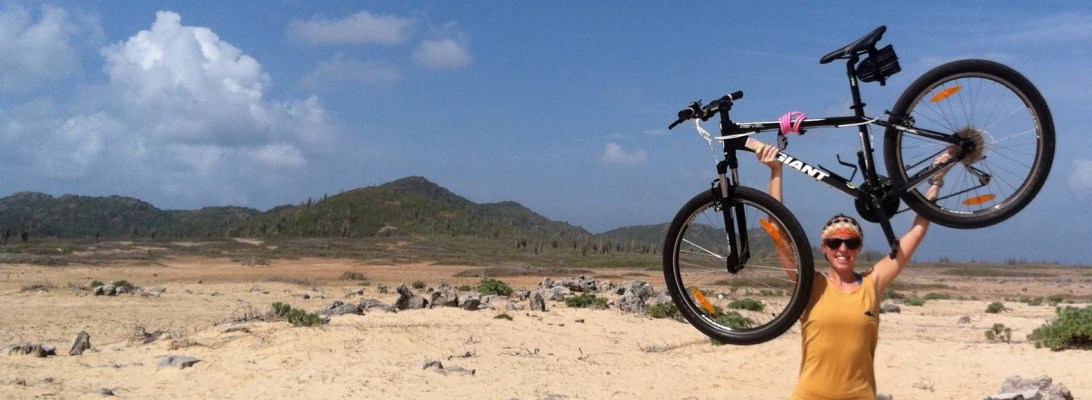
Seven years later, I’m kind of more coordinated and a little bit faster. But I’m stronger and I’m healthy and I’m not afraid to test my limits. This summer, I ran my first two triathlons, backpacked on the Appalachian Trail, swam across a whole lake, got lost in the middle of the woods and practically pooped myself as I sprinted out six fear-miles, I squatted the most I’ve ever squatted in my life, climbed the hardest route at my local climbing gym and I’ve gotten to do it all with my boyfriend and friends.
I’m still a clutz. I stubbed my toe and broke it (then ran a triathlon on it and hiked on the Appalachian Trail). I slammed my hand jumping up onto a plyo box bruising my right wrist beyond usability and gashing my palm open (then finished the rest of my box jumps and leg workout). While doing pullups, I let go of a resistance band that had been on my feet to slap me in the crotch (then kept doing pullups with the resistance band in my crotch). But I still did it, right?
I love motivating others to get healthy. And I have gotten to meet some amazing motivators in my own fitness journey: the moms at my gym with bomb booties and gorgeous smiles; my former co-worker, Stephanie, who continues to push herself (including biking across the country, completing a half-iron man, and being one of the sweetest women I’ve ever met); my friends Kelly and Rachel who have the most contagious love for the outdoors I’ve ever seen; my friend Maeve who taught me that swimming can be great, because you’re out of this world; my SCUBA instructors who taught me that the only way to succeed is to stop being such a damn spaz; and my super hero boyfriend whose idea of an “off day” is hot yoga and rock climbing.I like to think that the gym could use a few more people like me, who lack athleticism but don’t use it as an excuse. The gym needs somebody who isn’t afraid to turn to the body builder next to her and joke about the resistance band that just smacked her in the between-legs. I’ve met amazing people in my fitness journey, which to be honest, just like field hockey, is why I started in the first place. Everybody should know the feeling after a good workout, “good workout” being a completely relative term to the exerciser him/herself.
One day this last summer, my boyfriend, Chris, and I went to my high school track to do an interval workout for our triathlon training. But before I could do that, I had an old score to settle with the football field: the ladder. With Chris timing me, I finished that sprint in 1:45, the fastest I’ve ever been. Maybe I would have rather made that time in high school because then maybe I would have maybe made Varsity Field Hockey (let’s be honest, probably not). However, the amount of work I’ve been doing ever since high school ladders, the amount hours I’d spent with salty sweat down my face is really what made that time so damn sweet.
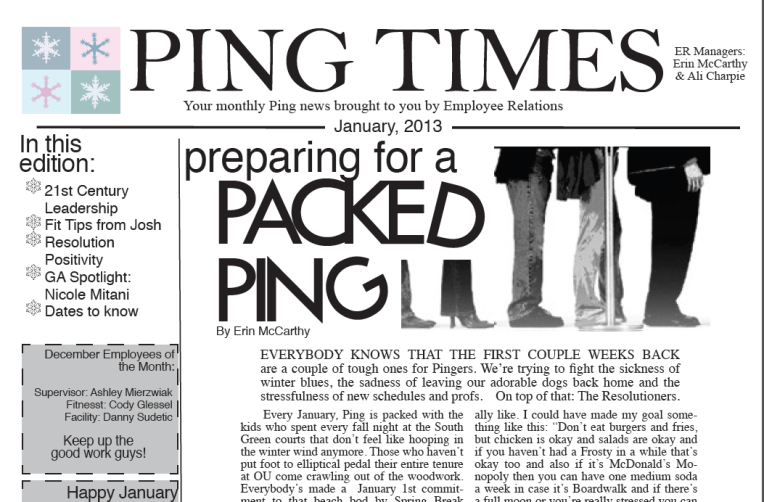
Cover Story: Preparing for a Packed Ping. This was an editorial I wrote directed at Ping Employees to stay positive when the fitness center is at it’s busiest time: Resolution Season.
EVERYBODY KNOWS THAT THE FIRST COUPLE WEEKS BACK
are a couple of tough ones for Pingers. We’re trying to fight the sickness of
winter blues, the sadness of leaving our adorable dogs back home and the
stressfulness of new schedules and profs. On top of that: The Resolutioners.
Every January, Ping is packed with the
kids who spent every fall night at the South
Green courts that don’t feel like hooping in
the winter wind anymore. Those who haven’t
put foot to elliptical pedal their entire tenure
at OU come crawling out of the woodwork.
Everybody’s made a January 1st commitment
to that beach bod by Spring Break
(which by the way is a gracing us a little early
this year…woo!) Ping is going to be packed.
My advice for dealing with this often
dreaded extra crowd? Stay Positive.
As a Pinger, you are not only swiping cards
and sanitizing sweat stains. Take this New
Year as an opportunity to make someone’s
resolution become his or her way of life.
It takes some guts to push oneself
into shape, and if a patron feels even a
little motivated by the Ping Staff, they
will be more likely to stick around.
New Year’s Resolutions have become
the bane of January— pretty much a joke
to a lot of people. “Another thing for me to
start and not finish” we say (subsequent eye
roll included). It’s a snapshot into the human
condition—the constant drive we have
to turn ourselves into better people, yet the
ironic constant laziness we welcome into
our homes with failed attempts at Resolution
Greatness. Ask someone in the middle
of July how their New Year’s Resolutions
are going and he or she will call you a name.
But for the last couple years, I’ve attempted
to make my resolutions count. I’ve thought
of things I want to do: spend less money,
eat fewer cakes, shower more, road rage
less. But what’s made me keep them is finding
a tangible way to really reach my goal.
For 2012, I decided I wasn’t going to
spend a single dollar at a fast food establishment;
my goal was to eat healthier and
spend less money, but I also found this to be
a way to not support an industry I didn’t really
like. I could have made my goal something
like this: “Don’t eat burgers and fries,
but chicken is okay and salads are okay and
if you haven’t had a Frosty in a while that’s
okay too and also if it’s McDonald’s Monopoly
then you can have one medium soda
a week in case it’s Boardwalk and if there’s
a full moon or you’re really stressed you can
have burgers and fries too.” That’s a lot of
gray area. So I just cut out any spending. If it
had a drive-thru, I wasn’t driving through it.
And here I am twelve months later and still
fast food free! (I probably won’t eat it this year
either, but now it’s really just out of fear that
my body isn’t used to it anymore and I will die.)
New Year’s Resolutions can be legit. They’re
just like goals. I’d encourage you Pingers to
not only set them yourselves, but to promote
them to patrons. If somebody checks out a
plyo box and starts banging their head against
it, maybe give ‘em a tip or two on exercises
they can do with it. If somebody’s in the corner
of the weight room crying in a ball because
they’re so lost and ‘JUST WANNA GET IN
SHAPE AGAIN’ maybe direct them to a machine
(One can only pray that this doesn’t
actually happen). Be supportive and positive!
It’s okay to complain to other Pingers
(in the privacy of the Sup’s office) about
the crowds, their cutoffs or the reek of your
new Ping sweatshirt (that you patiently
waited three months for) after an hour in
the weight room. Business can be stressful!
But I would encourage you to set a
little work goal yourself: Be encouraging
to the Resolutioners. Make a difference!
Chances are, as history tells us, Ping
won’t be as busy by the time February
rolls around, but that’s okay. If a few
people have felt encouraged and excited
about the awesome feeling from a great
Group Fitness class or an excellent workout,
I think we’re doing something right.
This article was published in The Essay Magazine on October 4, 2012:
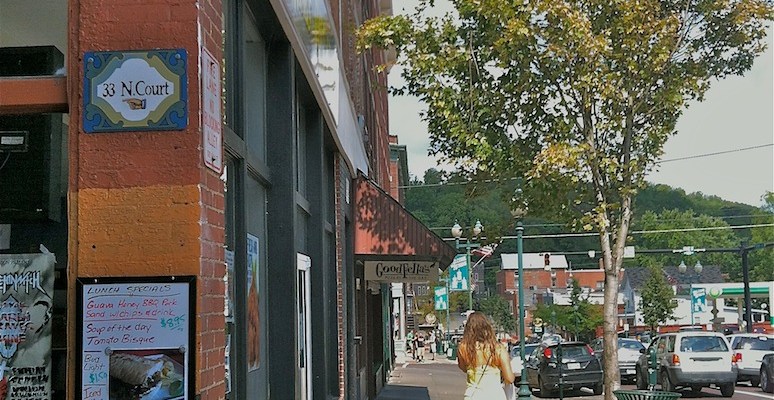
Take a turn into the alley at 33 N. Court Street and you’re greeted by Cuban music, growing in volume as you approach Sol’s front entrance. When you walk in the door of the Cuban Fusion restaurant,
you’ve entered an atmosphere like no other in Athens, Ohio.
As Sol owner Todd Wilson describes it, Sol is “a place where people can feel like they’re on vacation without having to leave Athens.”
Cuban-fusion cuisine got its name from the many cultural cuisines combined to create it, including Spanish, Carribbean and African. The meat is the central part of the dish, blended with vegetables, rice or beans.
“Everybody I know that has ever tried Cuban food loves it,” Wilson said, “It’s fresh, it’s different, but familiar enough ingredients that you’re not freaked out.”
Wilson grew up in Athens and met his wife here in grade school. His wife was born in Miami, Florida, where her parents had immigrated to the US from Cuba. They then moved to Athens. She and Martin moved to Miami in 1994 after they graduated from Ohio University. They spent ten years living in Miami, the Cuban-Fusion center of the United States, before moving back to Athens and starting Sol.

Sol began as a street buggy and opened it its new location on February 2 this year.
The restaurant has been using various local food products in its cuisine since it opened. Because of this, Sol’s menus and specials are constantly changing with the seasons and what is available locally.
For example, a recent dish offered was a shrimp avocado and mango salad that used a dressing made from Ohio’s own pawpaw.
“You can’t get that anywhere else,” Wilson said.
The restaurant has a bar with drink specials and dancing late on weekend nights. From 10:30-11:30pm, Sol hosts Salsa lessons with Cuban appetizers available, and from 11:30-2:00am, there is a DJ and open dancing on Fridays.
Sol is unique to Athens for its cuisine, its atmosphere, and its vacation-esque nightlife.
Check out Sol’s website at www.solrestaurant.net for menu updates, special events, and photos of the Cuban Fusion Cuisine.

Come on, you know you’ve Googled yourself before.
Who hasn’t? Whether it’s to check your LinkedIn profile or to see how high in the search results you show up, everyone has done it.
Now, Google your business. Where does it show up? Is it on the first page? Are competitors listed higher? Establishing an online presence is critical to the success of your business, and there are so many more ways to improve your presence than just crossing your fingers and hoping customers see your site before your competitors.
 The tactics that improve your online presence are collectively called search engine optimization, or SEO. Search engines like Google and Bing use sophisticated mathematical equations to determine how important and relevant your site is to whatever someone has typed in the search bar. The more relevant and important your site is to those search terms, the higher it will appear in the results.
Figuring out how to boost the visibility of your site isn’t a guessing game though. There are many factors that influence how search engines rank your site, including continually updated content (like a blog), well-written and authoritative information that people will want to share, language that takes advantage of highly-searched keywords and technical tactics like inbound and outbound links, meta tags and sitemaps.
Whether you’re building a new website or revamping your current site, you need to implement SEO tactics to ensure you maximize its potential. Creative Spot has helped many clients both optimize their existing websites for SEO and build new sites that take complete advantage of the latest SEO tactics.
To see how Creative Spot can help you best utilize SEO tools for your brand, contact us atinfo@creativespot.com or call us at 614.280.9280.
 Erin M. Holliday